 Add to Chrome
 Add to Firefox
 Add to Edge
Bagpiper: Solving Open-Ended Audio Tasks via Rich Captions
Feb 05, 2026
Current audio foundation models typically rely on rigid, task-specific supervision, addressing isolated factors of audio rather than the whole. In contrast, human intelligence processes audio holistically, seamlessly bridging physical signals with abstract cognitive concepts to execute complex tasks. Grounded in this philosophy, we introduce Bagpiper, an 8B audio foundation model that interprets physical audio via rich captions, i.e., comprehensive natural language descriptions that encapsulate the critical cognitive concepts inherent in the signal (e.g., transcription, audio events). By pre-training on a massive corpus of 600B tokens, the model establishes a robust bidirectional mapping between raw audio and this high-level conceptual space. During fine-tuning, Bagpiper adopts a caption-then-process workflow, simulating an intermediate cognitive reasoning step to solve diverse tasks without task-specific priors. Experimentally, Bagpiper outperforms Qwen-2.5-Omni on MMAU and AIRBench for audio understanding and surpasses CosyVoice3 and TangoFlux in generation quality, capable of synthesizing arbitrary compositions of speech, music, and sound effects. To the best of our knowledge, Bagpiper is among the first works that achieve unified understanding generation for general audio. Model, data, and code are available at Bagpiper Home Page.

Optimizing Conversational Quality in Spoken Dialogue Systems with Reinforcement Learning from AI Feedback
Jan 27, 2026Reinforcement learning from human or AI feedback (RLHF/RLAIF) for speech-in/speech-out dialogue systems (SDS) remains underexplored, with prior work largely limited to single semantic rewards applied at the utterance level. Such setups overlook the multi-dimensional and multi-modal nature of conversational quality, which encompasses semantic coherence, audio naturalness, speaker consistency, emotion alignment, and turn-taking behavior. Moreover, they are fundamentally mismatched with duplex spoken dialogue systems that generate responses incrementally, where agents must make decisions based on partial utterances. We address these limitations with the first multi-reward RLAIF framework for SDS, combining semantic, audio-quality, and emotion-consistency rewards. To align utterance-level preferences with incremental, blockwise decoding in duplex models, we apply turn-level preference sampling and aggregate per-block log-probabilities within a single DPO objective. We present the first systematic study of preference learning for improving SDS quality in both multi-turn Chain-of-Thought and blockwise duplex models, and release a multi-reward DPO dataset to support reproducible research. Experiments show that single-reward RLAIF selectively improves its targeted metric, while joint multi-reward training yields consistent gains across semantic quality and audio naturalness. These results highlight the importance of holistic, multi-reward alignment for practical conversational SDS.
Do Neural Codecs Generalize? A Controlled Study Across Unseen Languages and Non-Speech Tasks
Jan 18, 2026This paper investigates three crucial yet underexplored aspects of the generalization capabilities of neural audio codecs (NACs): (i) whether NACs can generalize to unseen languages during pre-training, (ii) whether speech-only pre-trained NACs can effectively generalize to non-speech applications such as environmental sounds, music, and animal vocalizations, and (iii) whether incorporating non-speech data during pre-training can improve performance on both speech and non-speech tasks. Existing studies typically rely on off-the-shelf NACs for comparison, which limits insight due to variations in implementation. In this work, we train NACs from scratch using strictly controlled configurations and carefully curated pre-training data to enable fair comparisons. We conduct a comprehensive evaluation of NAC performance on both signal reconstruction quality and downstream applications using 11 metrics. Our results show that NACs can generalize to unseen languages during pre-training, speech-only pre-trained NACs exhibit degraded performance on non-speech tasks, and incorporating non-speech data during pre-training improves performance on non-speech tasks while maintaining comparable performance on speech tasks.
Speech-Hands: A Self-Reflection Voice Agentic Approach to Speech Recognition and Audio Reasoning with Omni Perception
Jan 14, 2026We introduce a voice-agentic framework that learns one critical omni-understanding skill: knowing when to trust itself versus when to consult external audio perception. Our work is motivated by a crucial yet counterintuitive finding: naively fine-tuning an omni-model on both speech recognition and external sound understanding tasks often degrades performance, as the model can be easily misled by noisy hypotheses. To address this, our framework, Speech-Hands, recasts the problem as an explicit self-reflection decision. This learnable reflection primitive proves effective in preventing the model from being derailed by flawed external candidates. We show that this agentic action mechanism generalizes naturally from speech recognition to complex, multiple-choice audio reasoning. Across the OpenASR leaderboard, Speech-Hands consistently outperforms strong baselines by 12.1% WER on seven benchmarks. The model also achieves 77.37% accuracy and high F1 on audio QA decisions, showing robust generalization and reliability across diverse audio question answering datasets. By unifying perception and decision-making, our work offers a practical path toward more reliable and resilient audio intelligence.
BSCodec: A Band-Split Neural Codec for High-Quality Universal Audio Reconstruction
Nov 08, 2025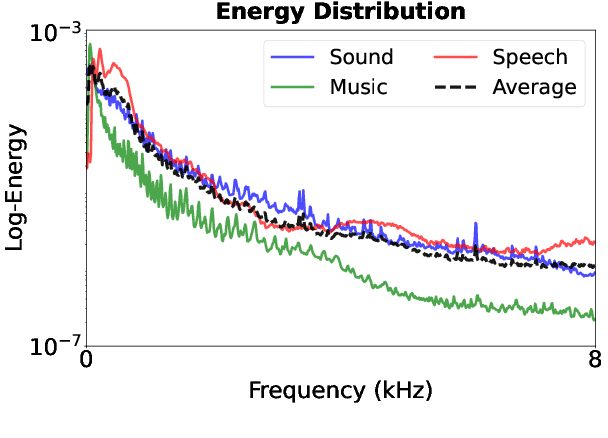
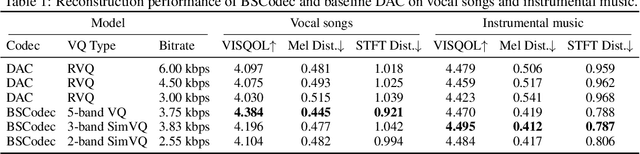
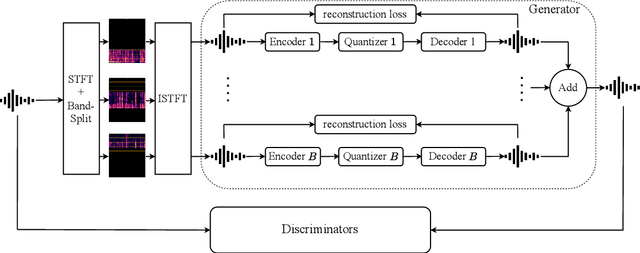
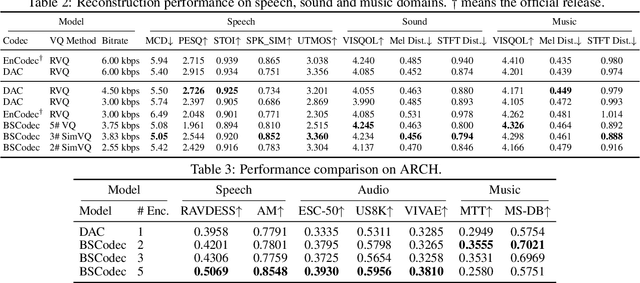
Neural audio codecs have recently enabled high-fidelity reconstruction at high compression rates, especially for speech. However, speech and non-speech audio exhibit fundamentally different spectral characteristics: speech energy concentrates in narrow bands around pitch harmonics (80-400 Hz), while non-speech audio requires faithful reproduction across the full spectrum, particularly preserving higher frequencies that define timbre and texture. This poses a challenge: speech-optimized neural codecs suffer degradation on music or sound. Treating the full spectrum holistically is suboptimal: frequency bands have vastly different information density and perceptual importance by content type, yet full-band approaches apply uniform capacity across frequencies without accounting for these acoustic structures. To address this gap, we propose BSCodec (Band-Split Codec), a novel neural audio codec architecture that splits the spectral dimension into separate bands and compresses each band independently. Experimental results demonstrate that BSCodec achieves superior reconstruction over baselines across sound and music, while maintaining competitive quality in the speech domain, when trained on the same combined dataset of speech, music and sound. Downstream benchmark tasks further confirm that BSCodec shows strong potential for use in downstream applications.
Evaluating Self-Supervised Speech Models via Text-Based LLMS
Oct 06, 2025Self-Supervised Learning (SSL) has gained traction for its ability to learn rich representations with low labeling costs, applicable across diverse downstream tasks. However, assessing the downstream-task performance remains challenging due to the cost of extra training and evaluation. Existing methods for task-agnostic evaluation also require extra training or hyperparameter tuning. We propose a novel evaluation metric using large language models (LLMs). By inputting discrete token sequences and minimal domain cues derived from SSL models into LLMs, we obtain the mean log-likelihood; these cues guide in-context learning, rendering the score more reliable without extra training or hyperparameter tuning. Experimental results show a correlation between LLM-based scores and automatic speech recognition task. Additionally, our findings reveal that LLMs not only functions as an SSL evaluation tools but also provides inference-time embeddings that are useful for speaker verification task.
Chain-of-Thought Reasoning in Streaming Full-Duplex End-to-End Spoken Dialogue Systems
Oct 02, 2025Most end-to-end (E2E) spoken dialogue systems (SDS) rely on voice activity detection (VAD) for turn-taking, but VAD fails to distinguish between pauses and turn completions. Duplex SDS models address this by predicting output continuously, including silence tokens, thus removing the need for explicit VAD. However, they often have complex dual-channel architecture and lag behind cascaded models in semantic reasoning. To overcome these challenges, we propose SCoT: a Streaming Chain-of-Thought (CoT) framework for Duplex SDS, alternating between processing fixed-duration user input and generating responses in a blockwise manner. Using frame-level alignments, we create intermediate targets-aligned user transcripts and system responses for each block. Experiments show that our approach produces more coherent and interpretable responses than existing duplex methods while supporting lower-latency and overlapping interactions compared to turn-by-turn systems.
ARECHO: Autoregressive Evaluation via Chain-Based Hypothesis Optimization for Speech Multi-Metric Estimation
May 30, 2025Speech signal analysis poses significant challenges, particularly in tasks such as speech quality evaluation and profiling, where the goal is to predict multiple perceptual and objective metrics. For instance, metrics like PESQ (Perceptual Evaluation of Speech Quality), STOI (Short-Time Objective Intelligibility), and MOS (Mean Opinion Score) each capture different aspects of speech quality. However, these metrics often have different scales, assumptions, and dependencies, making joint estimation non-trivial. To address these issues, we introduce ARECHO (Autoregressive Evaluation via Chain-based Hypothesis Optimization), a chain-based, versatile evaluation system for speech assessment grounded in autoregressive dependency modeling. ARECHO is distinguished by three key innovations: (1) a comprehensive speech information tokenization pipeline; (2) a dynamic classifier chain that explicitly captures inter-metric dependencies; and (3) a two-step confidence-oriented decoding algorithm that enhances inference reliability. Experiments demonstrate that ARECHO significantly outperforms the baseline framework across diverse evaluation scenarios, including enhanced speech analysis, speech generation evaluation, and noisy speech evaluation. Furthermore, its dynamic dependency modeling improves interpretability by capturing inter-metric relationships.
Context-Driven Dynamic Pruning for Large Speech Foundation Models
May 24, 2025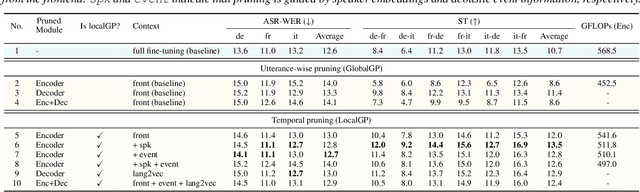
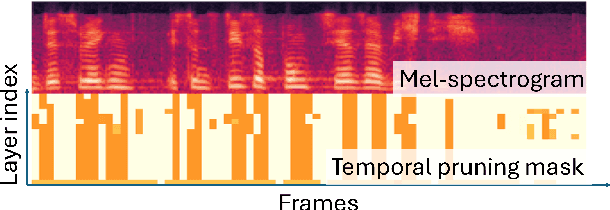
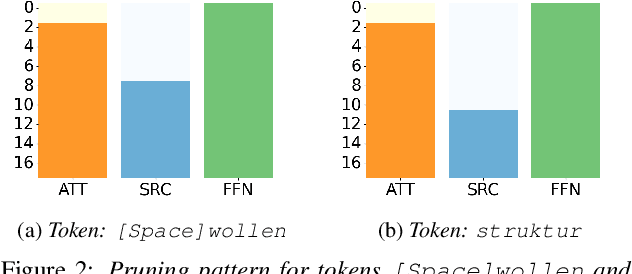
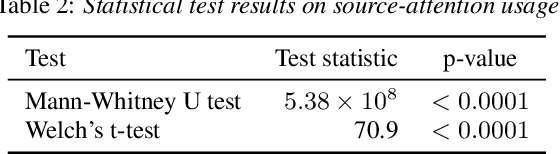
Speech foundation models achieve strong generalization across languages and acoustic conditions, but require significant computational resources for inference. In the context of speech foundation models, pruning techniques have been studied that dynamically optimize model structures based on the target audio leveraging external context. In this work, we extend this line of research and propose context-driven dynamic pruning, a technique that optimizes the model computation depending on the context between different input frames and additional context during inference. We employ the Open Whisper-style Speech Model (OWSM) and incorporate speaker embeddings, acoustic event embeddings, and language information as additional context. By incorporating the speaker embedding, our method achieves a reduction of 56.7 GFLOPs while improving BLEU scores by a relative 25.7% compared to the fully fine-tuned OWSM model.
ESPnet-SDS: Unified Toolkit and Demo for Spoken Dialogue Systems
Mar 11, 2025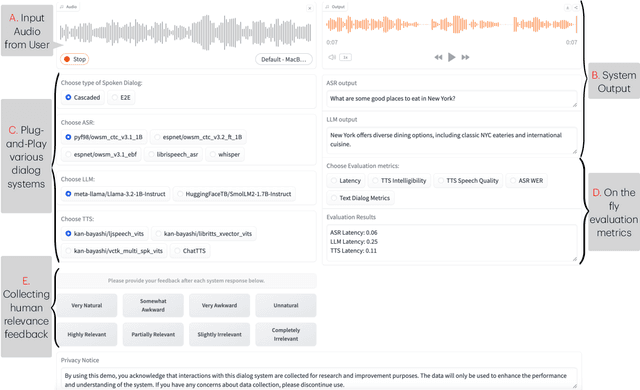
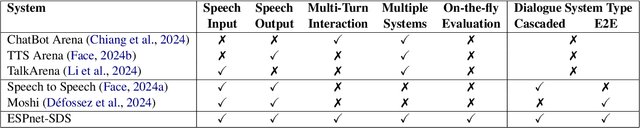
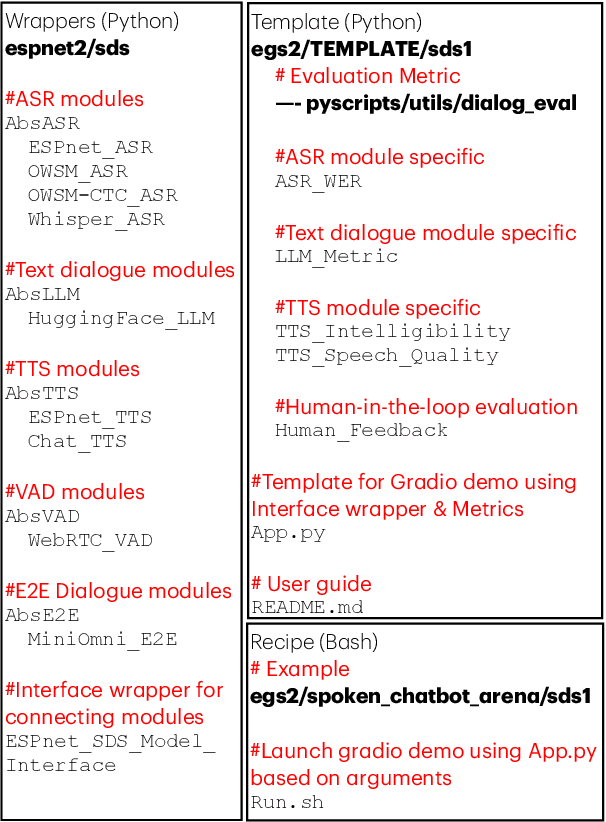
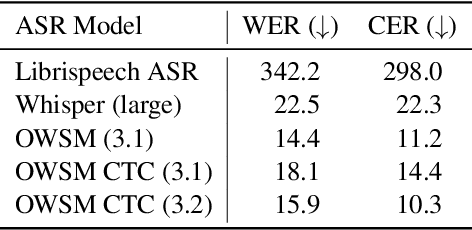
Advancements in audio foundation models (FMs) have fueled interest in end-to-end (E2E) spoken dialogue systems, but different web interfaces for each system makes it challenging to compare and contrast them effectively. Motivated by this, we introduce an open-source, user-friendly toolkit designed to build unified web interfaces for various cascaded and E2E spoken dialogue systems. Our demo further provides users with the option to get on-the-fly automated evaluation metrics such as (1) latency, (2) ability to understand user input, (3) coherence, diversity, and relevance of system response, and (4) intelligibility and audio quality of system output. Using the evaluation metrics, we compare various cascaded and E2E spoken dialogue systems with a human-human conversation dataset as a proxy. Our analysis demonstrates that the toolkit allows researchers to effortlessly compare and contrast different technologies, providing valuable insights such as current E2E systems having poorer audio quality and less diverse responses. An example demo produced using our toolkit is publicly available here: https://huggingface.co/spaces/Siddhant/Voice_Assistant_Demo.